Do You Have to Fix a Sewer Line Before Selling a House in Nashville?
You don't legally have to repair a sewer line before selling your Nashville home. Compare trenchless sewer repair vs. selling as-is for cash — and see which option nets you more.
What's in This Post
- How a failing sewer line affects your home sale
- Do you have to disclose sewer problems in Tennessee?
- How do I know if my sewer line is actually failing?
- What a sewer scope inspection reveals — and why buyers order one
- Option 1 — Repair the line with trenchless technology
- What trenchless sewer repair costs
- Option 2 — Sell the house as-is to a cash buyer
- Repair vs. sell as-is: side-by-side
- A real-world net-proceeds example
- How to decide in three steps
- Common mistakes Nashville sellers make
- Conclusion
- FAQ
How a failing sewer line affects your home sale
A sewer line is invisible right up until it isn’t — and once a buyer knows about it, it shapes the whole deal. Here’s what actually happens when a bad line meets a home sale:
- It shows up in the inspection. Serious buyers increasingly order a dedicated sewer scope on top of the general home inspection, especially for older Nashville homes. A camera doesn’t miss a collapsed pipe.
- It becomes a price negotiation. Once a defect is on paper, buyers ask for a repair credit or a price reduction — and they almost always ask for more than the repair actually costs, to cover their perceived risk.
- It can stall financing. Conventional, FHA, and VA appraisers can flag active sewage issues as a health-and-safety problem, which can hold up or sink a mortgage until it’s resolved.
- It scares buyers off entirely. “Sewer problem” reads as “expensive and gross” to most buyers. Deals fall through, and the home can sit longer, which itself drags the price down.
The takeaway: doing nothing isn’t really a third option. The line will affect your sale whether you address it up front or not. Your real decision is who deals with it — you, before listing, or the buyer, baked into a lower price.
Do you have to disclose sewer problems in Tennessee?
Repairing the line isn’t required, but honesty about it usually is. Tennessee is a disclosure state: most sellers complete the Tennessee Residential Property Condition Disclosure, which specifically asks about the condition of the plumbing and sewer or septic system. If you know the line is failing, that known material defect generally has to be disclosed. Staying quiet about a problem you’re aware of can turn into a lawsuit after closing — far more expensive than the repair itself.
It also helps to understand what you actually own. The sewer lateral — the pipe running from your house to the city main — is almost always the homeowner’s responsibility to maintain and repair, not Metro’s. The consortium 3 Rivers Wet Weather lays out a homeowner’s sewer responsibilities here, and it’s a clear primer on where your obligations begin and end. In most Nashville-area setups, you’re on the hook for the lateral from the house all the way to the connection at the main.
This article is general information, not legal advice.
How do I know if my sewer line is actually failing?
A slow drain now and then is normal. A failing sewer line usually announces itself in ways that are hard to ignore:
- Several fixtures slow down or back up at the same time — tub, toilet, and sink together, not just one drain
- Gurgling toilets, or water rising in one fixture when you run another or start the washing machine
- A sewage odor in the yard, basement, or crawlspace
- An unusually green, lush, or soggy strip of lawn tracing the pipe’s path to the street
- Backups that return within weeks of snaking or plunging — a sign of roots or a structural break, not a one-off clog
- Foundation cracks, indentations, or sinkholes in the yard above the line
- Rodents or insects appearing indoors, drawn in through a cracked pipe
Why Nashville homes are especially prone to it
Middle Tennessee’s shifting clay soil and freeze-thaw cycles put constant stress on buried pipe, and many Nashville neighborhoods still run on aging materials. Historic areas like East Nashville, Germantown, Belle Meade, and the urban core were often plumbed with clay or cast-iron pipe — and some mid-century homes used Orangeburg (tar-paper) pipe that’s now well past its lifespan. Clay joints invite tree-root intrusion; cast iron corrodes and scales; Orangeburg simply collapses. If your home predates the 1980s, assume the line deserves a look before you list.
Recurring clogs are worth taking seriously rather than repeatedly snaking. When roots or grease are the cause, professional drain cleaning and hydro jetting clear the line properly, and leak detection pinpoints hidden breaks before they become emergencies.
What a sewer scope inspection reveals — and why buyers order one
The only way to know the true condition of a line is to send a camera down it. A CCTV sewer camera inspection runs a waterproof camera through the pipe and records exactly what’s there. In under an hour it shows:
- Cracks, offsets, and collapsed sections — and precisely how far down the line they are
- Root intrusion and where it’s entering the pipe
- Bellies or sags where waste and water pool
- Pipe material and diameter (so you know if you’re dealing with clay, cast iron, or Orangeburg)
- Whether the damage calls for a spot repair, a full liner, or replacement
Here’s the strategic part: whoever gets the camera footage first controls the conversation. If the buyer’s inspector finds the problem, you’re negotiating from a defensive crouch. If you scope the line before listing, you walk in with a diagnosis, a plan, and a real repair quote — which is exactly the number you need to weigh against any cash offer. Prodigy offers a free camera inspection, so there’s little reason to guess.
Option 1 — Repair the line with trenchless technology
If the house is otherwise in good shape and you want the highest possible sale price, repairing the line first is usually the smart move — and modern trenchless (no-dig) methods make that far less painful than the backhoe-in-the-front-yard repairs of the past. Trenchless fixes the pipe through small access points instead of an open trench, so your lawn, driveway, mature trees, and hardscaping stay intact — which matters a great deal when curb appeal is about to be on display.
The main trenchless methods
| Method | How it works | Best for |
|---|---|---|
| CIPP lining | A resin-saturated liner is inserted and cured in place, forming a new pipe inside the old one | Cracked, leaking, or root-damaged pipe that’s still structurally intact |
| Pipe bursting | A new pipe is pulled through while a bursting head fractures the old one outward | Pipe that’s collapsed, badly deteriorated, or undersized |
| Spot / point repair | A short liner patches a single defect without lining the whole run | One isolated crack or joint failure |
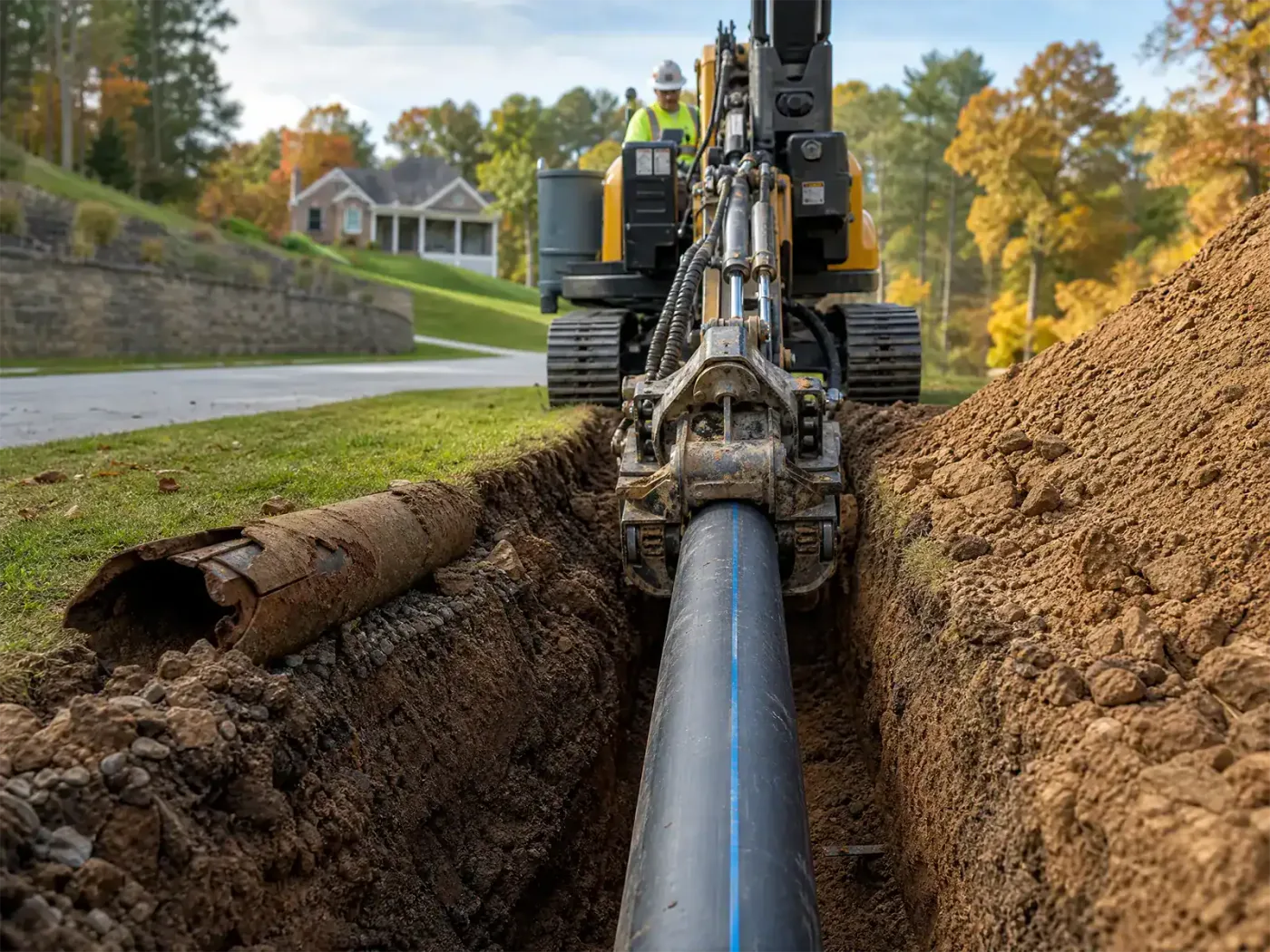
For clogs and roots rather than structural damage, targeted drain cleaning or hydro jetting may be all it takes to hand a buyer a clean inspection report. And once repairs are done, a sewer maintenance plan keeps the line clear through closing. If your property is on septic rather than city sewer, a septic inspection and any needed septic repair serve the same purpose.
Why sellers choose trenchless before listing
- Higher sale price. A camera-verified, warrantied line removes the single biggest bargaining chip a buyer has.
- Faster than excavation. Most trenchless jobs finish in one to two days versus four to seven for dig-and-replace — it rarely delays a listing.
- Lower cost. Trenchless typically runs 30–50% less than traditional excavation once you factor in landscape and driveway restoration.
- Long lifespan. A cured-in-place liner is built to last 50+ years — a genuine selling point you can put in the listing.
- No torn-up yard. Curb appeal stays intact right when it counts most.
Want proof it works on real Nashville properties? See our Nashville condo sewer rehabilitation case study and the Gulch trenchless pipeline repair project. If a line fails right before closing, emergency sewer and drain service is available 24/7 to keep the deal on track.
What trenchless sewer repair costs
Every line is different — length, depth, pipe material, and how many access points are needed all move the number. As a general guide, though, here’s how the options tend to compare nationally. Treat these as ballparks; your exact figure comes from a camera inspection.
| Repair type | Typical range* | Timeline |
|---|---|---|
| Drain cleaning / hydro jetting | $150 – $800 | Same day |
| Spot / point repair | $1,000 – $4,000 | 1 day |
| CIPP full-length lining | $80 – $250 per foot | 1 – 2 days |
| Pipe bursting (replacement) | $6,000 – $12,000+ | 1 – 2 days |
| Traditional dig-and-replace | $8,000 – $30,000+ | 4 – 7 days |
*Illustrative national ranges for planning only — not a quote. Nashville pricing varies with site conditions; Prodigy provides an exact figure after a free camera inspection, and current specials and coupons (including $500 off trenchless service) can bring the cost down further.
Option 2 — Sell the house as-is to a cash buyer
Repairing doesn’t always make sense. Maybe the damage is severe, the estimate is eye-watering, you’re on a hard deadline, or you just don’t want to manage contractors and showings on top of everything else life is throwing at you. In those cases, you can sell the house exactly as it stands.
Cash buyers purchase homes in any condition — sewer and plumbing problems included — and they close fast. According to HouseCashin’s Nashville data, most local cash home buying companies skip the appraisal, inspection and financing contingencies that in a typical traditional transaction with a bad sewer line or plumbing issues would have been derailed. There are no repairs, no realtor commissions, no staging, and no open houses when selling a home to investor.
When selling as-is is the better call
- The line is badly collapsed and the repair estimate rivals what you’d net on the open market
- You’re relocating, settling an inherited property, or facing a time-sensitive financial situation
- The home needs other major work beyond the sewer and you don’t want to sink money into it
- You value speed and certainty over squeezing out the last few thousand dollars
The trade-off is straightforward: a cash offer typically comes in below full retail, because the buyer is pricing in the repair plus the risk they’re taking on. For many sellers in a tough spot, that discount is well worth the speed, certainty, and zero out-of-pocket cost.
Repair vs. sell as-is: side-by-side
The honest comparison, factor by factor:
| Factor | Repair, Then Sell | Sell As-Is for Cash |
|---|---|---|
| Best for | Homes in good shape where you want top dollar | Severe damage, tight timelines, or wanting out fast |
| Upfront cost | You pay for the repair (trenchless is 30–50% cheaper than digging) | $0 — the buyer takes on the repair |
| Timeline | Trenchless finishes in 1–2 days, then you list | Offers in days; many closings in 1–4 weeks |
| Sale price | Full market value once the line passes inspection | Below retail — buyer prices in repair and risk |
| Financing risk | Removed once the line is fixed | None — cash buyers skip appraisals |
| Hassle | One contractor, then a normal sale | No repairs, showings, or realtor fees |
| Who handles it | A licensed trenchless contractor (Prodigy) | A vetted cash buyer (via HouseCashin) |
A real-world net-proceeds example
Numbers make the trade-off concrete. Here’s a simplified, hypothetical Nashville home with a cracked sewer lateral. Your real figures will differ, but the shape of the decision holds:
ILLUSTRATIVE EXAMPLE — NOT A GUARANTEE
Home’s full market value (fixed): $400,000
Path A — Repair, then list on the open market
- Trenchless repair: −$7,000
- Agent commission + closing costs (~7%): −$28,000
- Net to you: about $365,000, in roughly 45–70 days
Path B — Sell as-is for cash
- Cash offer (as-is, buyer absorbs repair + margin): ~$340,000
- No commission, no closing costs, no repair: −$0
- Net to you: about $340,000, in roughly 1–3 weeks
Read it this way: Path A nets more money if you can afford the repair and the wait. Path B nets less but gets you cash quickly with zero effort or risk. The right answer depends on which you value more — dollars or speed and certainty.
How to decide in three steps
- Get a camera inspection first. You can’t choose intelligently without the real scope. A sewer camera inspection gives you an exact diagnosis — the foundation for every number that follows.
- Get both quotes. Ask Prodigy for a repair estimate and request a cash offer through HouseCashin. Now you’re comparing real figures instead of worst-case fears.
- Compare net proceeds, not sticker prices. Subtract the repair, commissions, and closing costs from each path. If the repair is modest and the home is strong, fix it and list for full value. If the repair is large or your timeline is short, take the cash route. Sometimes the answer is a blend — repair a minor issue, but sell as-is when the damage is severe.
Common mistakes Nashville sellers make
- Ignoring the warning signs and hoping. A recurring backup doesn’t fix itself, and it will surface in the buyer’s inspection at the worst possible moment.
- Repeatedly snaking a structural problem. Snaking clears a symptom; a cracked or root-invaded pipe needs a real repair. Money spent snaking over and over is money wasted.
- Letting the buyer scope the line first. Whoever holds the camera footage controls the negotiation. Get ahead of it.
- Assuming excavation is the only fix. Many sellers picture a torn-up yard and a five-figure bill; trenchless is often faster and markedly cheaper.
- Under-disclosing a known defect. It can void the sale or invite a lawsuit later. Disclose, and either fix it or price it in.
- Accepting the first cash offer without a repair quote. Without knowing the repair cost, you can’t tell whether an as-is offer is fair. Get both numbers.
NOT SURE HOW BAD IT IS? START HERE.
Before you drop your asking price or accept a lowball offer, find out what you’re actually dealing with. Prodigy Sewer & Drain will camera-inspect your line for free and give you a straight repair quote you can weigh against any cash offer. Call (629) 276-6322 or schedule your free camera inspection — serving Nashville, Franklin, and all of Middle Tennessee.
Conclusion
- You’re not legally required to repair a sewer line before selling a house in Nashville.
- A failing line still affects your sale — through inspections, financing, and price negotiations — so “do nothing” isn’t really an option.
- If you know the line is failing, you generally must disclose it; hiding it invites a lawsuit.
- Repair with trenchless to sell at full value — fast, no digging, and 30–50% cheaper than excavation.
- Or sell as-is to a cash buyer to skip repairs entirely, for a price below full retail.
- Get a camera inspection and both quotes, then compare net proceeds — not sticker prices — before you decide.
ABOUT THE AUTHOR
Prodigy Sewer & Drain is a family-owned, licensed, insured, and bonded trenchless sewer, drain, and septic contractor serving Nashville, Franklin, and Middle Tennessee since 2012. Specializing in no-dig pipe rehabilitation, CCTV camera diagnostics, drain cleaning, hydro jetting, and 24/7 emergency service, the Prodigy team has helped homeowners across Davidson and Williamson counties protect property value and pass inspections for more than 13 years.
504 Autumn Springs Court, Suite 16, Franklin, TN 37067 · (629) 276-6322 · prodigytrenchless.com
Frequently Asked Questions
Do I have to fix a sewer line before selling a house in Nashville?
No. There’s no Tennessee law requiring the repair. But because the problem surfaces in the buyer’s inspection and can affect financing, you’ll typically either fix it, disclose it and adjust price, or sell as-is to a cash buyer.
Do I have to disclose sewer problems when selling in Tennessee?
Generally yes. Tennessee’s residential property condition disclosure covers the plumbing and sewer or septic system, so a known material defect should be disclosed. Confirm the specifics with a Tennessee real estate attorney.
How much does trenchless sewer repair cost in Nashville?
It depends on length, depth, and pipe condition, but trenchless typically runs 30–50% less than traditional dig-and-replace, and most jobs finish in one to two days. A free camera inspection produces an exact quote.
What is a sewer scope, and should I get one before listing?
A sewer scope is a camera inspection that records the inside of your line. Getting one before you list means you control the diagnosis and the repair quote instead of reacting to the buyer’s inspector. Prodigy offers a free camera inspection.
Can I sell a house as-is with a broken sewer line?
Yes. Cash buyers purchase homes in any condition, sewer issues included. Services like HouseCashin match Nashville homeowners with vetted investors who buy as-is and cover closing costs, though offers run below full retail.
Will a bad sewer line stop a buyer from getting a mortgage?
It can. Conventional, FHA, and VA appraisers may flag an active sewage problem as a health-and-safety issue, which can delay or block financing until it’s repaired — one more reason to address it before listing.
How long does trenchless sewer repair take?
Most trenchless repairs finish in one to two days, versus four to seven days for traditional excavation, so it rarely holds up a listing or a closing.
Does a new sewer line add value when selling?
It removes a major objection and protects your price rather than adding a premium on top. A warrantied, camera-verified line reassures buyers, keeps financing on track, and prevents the price erosion a known defect causes.
Know What You Are Selling — Or Buying
Whoever gets the camera footage first controls the negotiation. Prodigy will inspect the line and give you a straight repair quote you can weigh against any offer. Call or text (629) 276-6322.