
Signs of a Failing Septic System: Middle TN Guide
Learn the 7 signs of a failing septic system in Middle Tennessee. Know what to look for before a backup becomes a $20,000+ problem.
Quick Answer: The seven main signs of a failing septic system are: slow drains throughout the home, gurgling sounds from toilets or drains, sewage or sulfur odors indoors or in the yard, standing water or soggy ground over the drain field without recent rainfall, unusually lush or bright-green grass patches over the drain field, sewage backing up into fixtures, and needing the tank pumped more than every 3 years. In Middle Tennessee, clay-heavy soils accelerate drain field failure — catching these signs early can be the difference between a manageable repair and a full system replacement costing $15,000 to $35,000.
About 25% of Tennessee households rely on private septic systems rather than municipal sewer — and in Middle Tennessee’s rural and semi-rural communities, from the outskirts of Nashville through Williamson, Rutherford, Wilson, and Maury Counties, that percentage is significantly higher. For homeowners on septic, the system runs silently as long as it’s working. The problem is that the early warning signs of failure are easy to miss or explain away — until the problem has progressed to a point where it’s both obvious and expensive.
Middle Tennessee has a specific complication that homeowners in other regions may not face as acutely: clay-heavy soils dominate the region’s geology, particularly in the Middle Tennessee basins. Clay absorbs wastewater far more slowly than sandy or loamy soil. A drain field that might function adequately in sandy soil may struggle in Middle Tennessee clay, and one that’s been in service for 15 to 20 years may be approaching the end of its absorption capacity — especially during the region’s peak rainfall season from March through May.
Prodigy Sewer & Drain serves Middle Tennessee homeowners with septic inspection, pumping, repair, and drain cleaning services. This guide covers the seven warning signs we consistently see before a system reaches emergency status — and what to do when you see them.
What's in This Post
- Sign 1: Slow Drains Throughout the House — Not Just One Fixture
- Sign 2: Gurgling Sounds from Drains or Toilets
- Sign 3: Sewage or Sulfur Odors Indoors or in the Yard
- Sign 4: Standing Water or Soggy Ground Over the Drain Field
- Sign 5: Unusually Lush or Green Grass Over the Drain Field
- Sign 6: Sewage Backing Up Into Fixtures Inside the Home
- Sign 7: Needing the Tank Pumped More Often Than Every 3 to 5 Years
- What Makes Middle Tennessee Septic Systems Especially Vulnerable?
- What Should You Do When You See These Warning Signs?
- TL;DR — Signs of a Failing Septic System
- FAQ
Sign 1: Slow Drains Throughout the House — Not Just One Fixture
A single slow drain is almost never a septic problem — it’s typically a localized clog near that fixture. But when multiple drains throughout the home begin draining slowly at the same time — the kitchen sink, the master bath, the laundry drain — that pattern points to the main system rather than a single pipe.
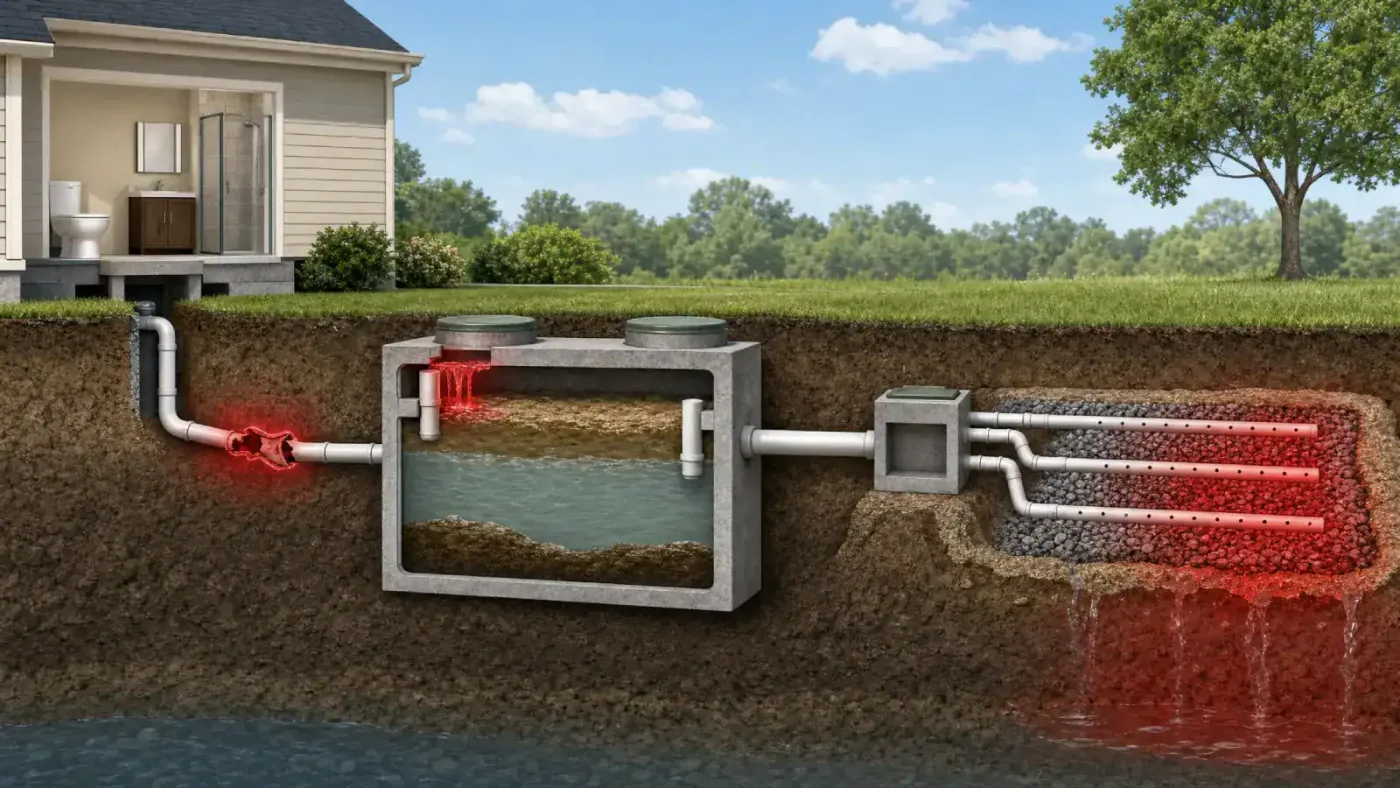
When the septic tank approaches capacity or the drain field begins losing absorption ability, wastewater backs up in the drain lines throughout the home because there’s nowhere for it to go. The result is system-wide sluggishness that basic drain cleaning won’t resolve, because the root problem isn’t in the pipes — it’s in the tank or field.
Take action: If you have slow drains throughout the home and haven’t had your tank pumped in 3+ years, call for a pumping and inspection. Do not use chemical drain cleaners — they don’t address the underlying cause and can disrupt the bacterial balance needed for septic function.
Sign 2: Gurgling Sounds from Drains or Toilets
Gurgling from drains or toilets — particularly after flushing or after significant water use — is caused by air being displaced through the plumbing system. In a properly functioning septic system, wastewater flows smoothly down through the lines to the tank with air moving normally through vent pipes. When the system is backing up, wastewater and gas don’t have a smooth path, and air bubbles back up through the plumbing, producing the gurgling sound.
This is typically an early-stage warning sign — it often appears before the more obvious symptoms like odors and standing water. Homeowners in Middle Tennessee who hear persistent gurgling in the toilet after flushing or in drains after running water should treat it as a prompt to call for inspection, not something to ignore.
Sign 3: Sewage or Sulfur Odors Indoors or in the Yard
A functioning septic system should not produce noticeable odors. Faint earthiness near the tank lid or drain field after heavy rain can be normal — but strong sewage or hydrogen sulfide (rotten egg) smells, whether inside the home or in the yard, are not.
Indoor odors typically mean the system pressure is allowing sewer gases to push back through fixture traps — which happens when the system is overfull or partially blocked. Outdoor odors near the drain field or tank indicate leakage or overflow. Both situations require professional assessment.
Health note: Hydrogen sulfide — the gas responsible for rotten egg smell — is toxic at elevated concentrations and can cause headaches, nausea, and respiratory irritation. In enclosed spaces like basements or crawl spaces near failing septic components, concentrations can reach hazardous levels. Do not ignore persistent sewage odors inside the home.
Sign 4: Standing Water or Soggy Ground Over the Drain Field
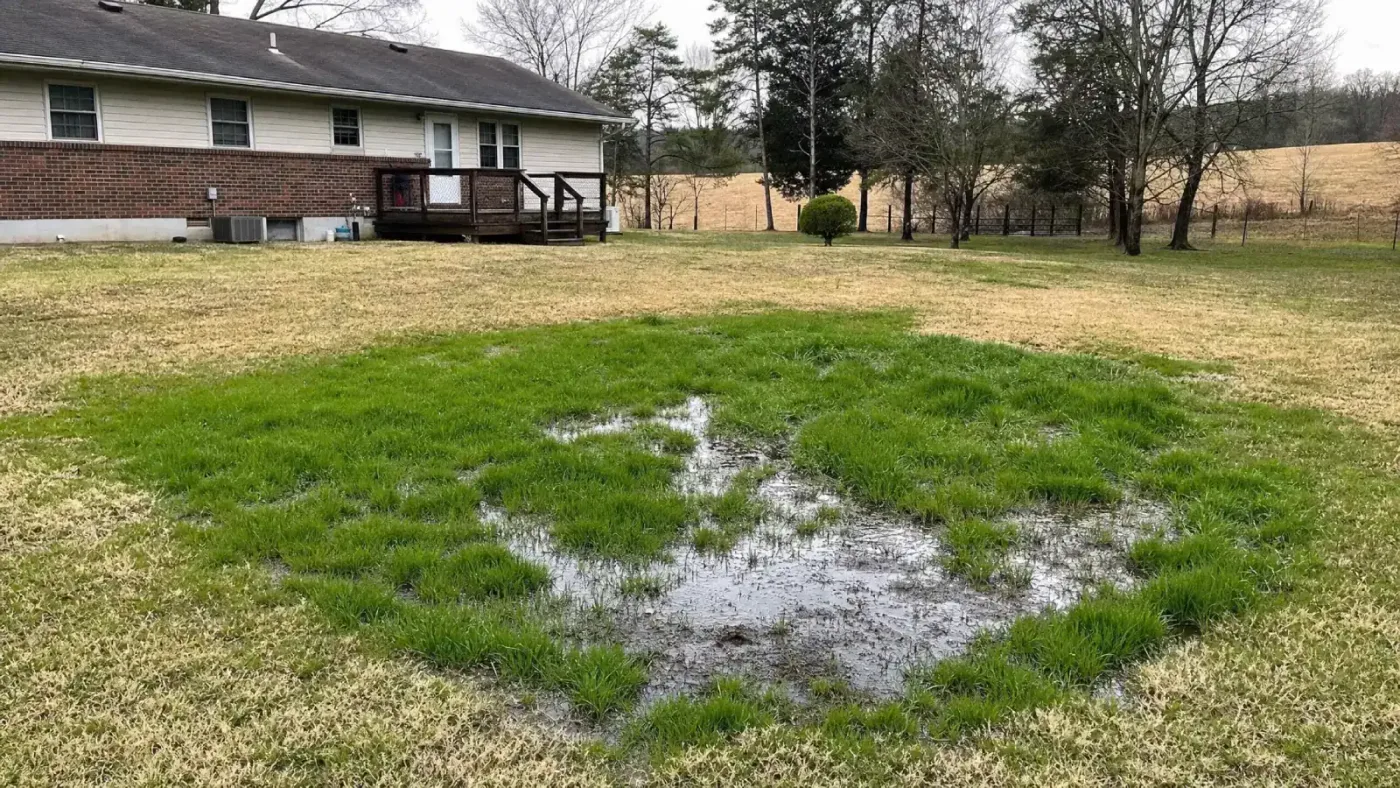
This is one of the clearest visible signs of drain field failure. When you see standing water, soggy ground, or consistently wet, spongy soil over the area where your drain field runs — particularly during dry weather when the surrounding yard is normal — wastewater is surfacing through the soil rather than being absorbed underground.
In Middle Tennessee’s clay-heavy soils, this happens when the soil’s absorption capacity is exhausted — the biomat (the layer of organic material that forms at the soil-pipe interface) has thickened to the point where effluent can no longer penetrate, forcing it to the surface. Once a drain field reaches this state, pumping the tank alone provides only temporary relief; the field itself needs assessment and possibly rehabilitation or replacement.
Safety warning: Wastewater surfacing over a drain field contains pathogens including bacteria and viruses. Keep children and pets away from the area. Do not walk through it without protective footwear. Contact your local health department or a licensed septic service provider.
Sign 5: Unusually Lush or Green Grass Over the Drain Field
Grass grows remarkably well when it has access to excess nutrients — and wastewater leaking into the root zone provides exactly that. If a patch of grass over your drain field is noticeably greener, taller, or more lush than the surrounding lawn, especially during dry periods when the rest of the yard is struggling, effluent is likely surfacing below the grass line and fertilizing it.
This sign is easy to miss or attribute to natural variation in the lawn. But an area that was uniform with the surrounding yard and has become visibly different over the drain field location is almost always telling you something about the system’s performance. This is a mid-stage warning sign — the field is failing but may not yet have progressed to surface ponding.
Sign 6: Sewage Backing Up Into Fixtures Inside the Home
This is the emergency sign. When sewage or wastewater backs up out of drains, toilets, or floor drains into the home, the system has reached or exceeded its capacity. This is not a situation where further use of the plumbing is safe or advisable.
If sewage is actively backing up: Stop all water use in the home immediately. Do not flush toilets or run any water. Keep people and pets away from any sewage-contaminated areas — contact with raw sewage presents serious health risks including E. coli, hepatitis A, and other pathogens. Call a licensed septic service for emergency response.
Sewage backups in Middle Tennessee can have multiple causes: a full tank that hasn’t been pumped, a blockage in the line between the home and the tank, or a failed drain field that is sending effluent backward. A camera inspection of the lines and assessment of the tank level determines the actual cause — and the appropriate response.
Sign 7: Needing the Tank Pumped More Often Than Every 3 to 5 Years
The Tennessee Department of Health recommends pumping a septic tank approximately every 3 to 5 years under normal household use. If your tank is reaching capacity significantly faster — needing pumping every 1 to 2 years — that frequency is telling you that either the tank is undersized for the household or, more commonly, that the drain field is no longer accepting effluent properly and is sending it back into the tank.
A tank that fills rapidly despite normal household water use is essentially showing you that the drain field is not doing its job. Pumping relieves the immediate pressure but doesn’t repair the field. Without addressing the underlying field condition, the tank will fill again quickly — and the cycle will continue until the drain field is rehabilitated or replaced.
What Makes Middle Tennessee Septic Systems Especially Vulnerable?
Middle Tennessee homeowners on septic face conditions that accelerate system failure compared to regions with better-draining soils:
- Clay-heavy soils: The Middle Tennessee basin geology features clay-dominant soils that absorb wastewater far more slowly than sandy soils. A drain field that might last 30 years in sandy soil may struggle after 15 to 20 years in clay. The TDEC (Tennessee Department of Environment and Conservation) requires alternative system designs — mound systems, pressure-dosed systems, spray systems — for sites with clay content above a specified threshold, precisely because conventional gravity drain fields often fail prematurely in these conditions.
- Seasonal rainfall peaks: Tennessee receives peak rainfall from March through May. During this period, soils in Middle Tennessee are already near saturation from winter moisture, and the additional spring rainfall further reduces the drain field’s absorption capacity. Homeowners who notice symptoms in spring — particularly drain field ponding or indoor slow drains — are often seeing the combination of a marginal system and seasonal soil saturation.
- Aging system stock: Many Middle Tennessee rural and semi-rural properties have septic systems installed in the 1970s, 1980s, and early 1990s — systems now 30 to 50 years old. These systems were designed for smaller household water use than today’s typical household, and many were installed before modern engineering requirements for clay soil conditions were in place.
What Should You Do When You See These Warning Signs?

Acting early is the single most important thing a Middle Tennessee homeowner can do when septic warning signs appear. Early intervention consistently costs less than emergency response:
- Reduce water use immediately: Less water entering the system reduces the load and buys time. Spread out laundry, shorten showers, fix dripping faucets, and avoid running dishwasher and washing machine on the same day.
- Do not use septic additives or chemical treatments: Products claiming to “fix” failing septic systems through additives are not effective for drain field failure and can disrupt the bacterial balance the tank requires for proper decomposition. The EPA recommends against their use.
- Call a licensed septic service for inspection: A professional inspection assesses the tank level, the condition of the lines, and whether the drain field is showing signs of saturation. This is the only way to accurately determine the cause and the appropriate response.
- Contact the Tennessee Department of Health if needed: For questions about permits, system replacement, or county health department contacts, TDEC administers Tennessee’s subsurface sewage disposal regulations under Chapter 0400-48-01.
TL;DR — Signs of a Failing Septic System
- Sign 1: Multiple slow drains throughout the home (not just one fixture).
- Sign 2: Gurgling sounds from toilets or drains after water use.
- Sign 3: Sewage or sulfur odors indoors or in the yard near the drain field.
- Sign 4: Standing water or soggy ground over the drain field during dry weather.
- Sign 5: Unusually lush or bright-green grass patches specifically over the drain field.
- Sign 6: Sewage actively backing up into toilets, drains, or floor drains — a health emergency.
- Sign 7: Tank needing pumping more often than every 3 to 5 years.
- Middle Tennessee’s clay soils and seasonal rainfall make drain field failure faster than many homeowners expect.
- Contact Prodigy Sewer & Drain for inspection, pumping, and emergency service in Middle Tennessee.
Frequently Asked Questions
What are the signs of a failing septic system?
The main signs are: slow drains throughout the home (multiple fixtures, not just one), gurgling sounds from toilets or drains, sewage or sulfur odors indoors or in the yard, standing water or soggy ground over the drain field without recent rainfall, unusually lush grass patches over the drain field, sewage backing up into fixtures, and needing the tank pumped more often than every 3 to 5 years. In Middle Tennessee, clay-heavy soils make drain field saturation happen faster than many homeowners expect — catching these signs early is critical.
How do I know if my drain field is failing?
Signs of a failing drain field include standing water or soggy ground over the field area during dry weather, unusually green or lush grass directly over the field compared to surrounding areas, sewage odor in the yard near the field, and slow drains or sewage backups inside the home. If wastewater is visibly surfacing over the drain field, that is a health hazard requiring immediate professional assessment — keep people and pets away from the area.
How often should a septic tank be pumped in Tennessee?
The Tennessee Department of Health recommends pumping every 3 to 5 years under normal household use. If you’re needing pumping more often than every 3 years, that frequency is a warning sign of an underlying problem — the drain field may not be accepting effluent properly. Pumping alone won’t fix a field issue; a professional inspection is needed to identify the cause.
What makes septic systems fail faster in Middle Tennessee?
Middle Tennessee’s clay-heavy soils absorb wastewater much more slowly than sandy or loamy soil. When a drain field in clay soil becomes saturated, effluent has nowhere to go and either surfaces in the yard, backs up into the home, or contaminates groundwater. The region’s peak spring rainfall (March through May) further stresses marginal drain fields. Many Middle Tennessee systems installed before modern engineering requirements for clay conditions were in place are now reaching end of useful life.
What should I do if I see signs of septic system failure?
Immediately reduce water use in the home to limit system load. Keep people and pets away from any areas where sewage may be surfacing. Do not use additives or chemicals claiming to fix the problem. Call a licensed septic service provider for a professional inspection — do not wait. Early intervention costs significantly less than emergency response or full system replacement, which can run $15,000 to $35,000 for Middle Tennessee properties with clay soil conditions.
Related Resources
- Prodigy Sewer & Drain — Septic Services Middle Tennessee
- Septic Tank Pumping
- Septic Inspection
- Emergency Septic Services in Nashville
Think Your Middle Tennessee Septic System Is Failing? Call Prodigy
Prodigy Sewer & Drain provides septic tank pumping, inspection, drain cleaning, and emergency sewer service throughout Middle Tennessee. If you’re seeing any of the warning signs described above, contact us for a professional assessment before the problem reaches emergency status.
About Prodigy Sewer & Drain | Prodigy Sewer & Drain provides drain cleaning, hydrojetting, sewer repair, and septic services throughout Middle Tennessee, including Nashville and surrounding counties. Services include septic tank pumping, inspection, drain line camera inspection, hydrojetting, and emergency sewer response. Contact Prodigy for reliable, licensed service across the Middle Tennessee region.
Catch Septic Trouble Before It Surfaces
Inspection, pumping, repair and grinder pumps across Davidson and Williamson counties — from a crew that will tell you when the system is fine. Call or text (629) 276-6322.