What Is a Grinder Pump? Nashville Homeowner Guide
Wondering what a grinder pump is and if your Nashville property needs one? Learn how it works, key components, and when to call a licensed specialist.
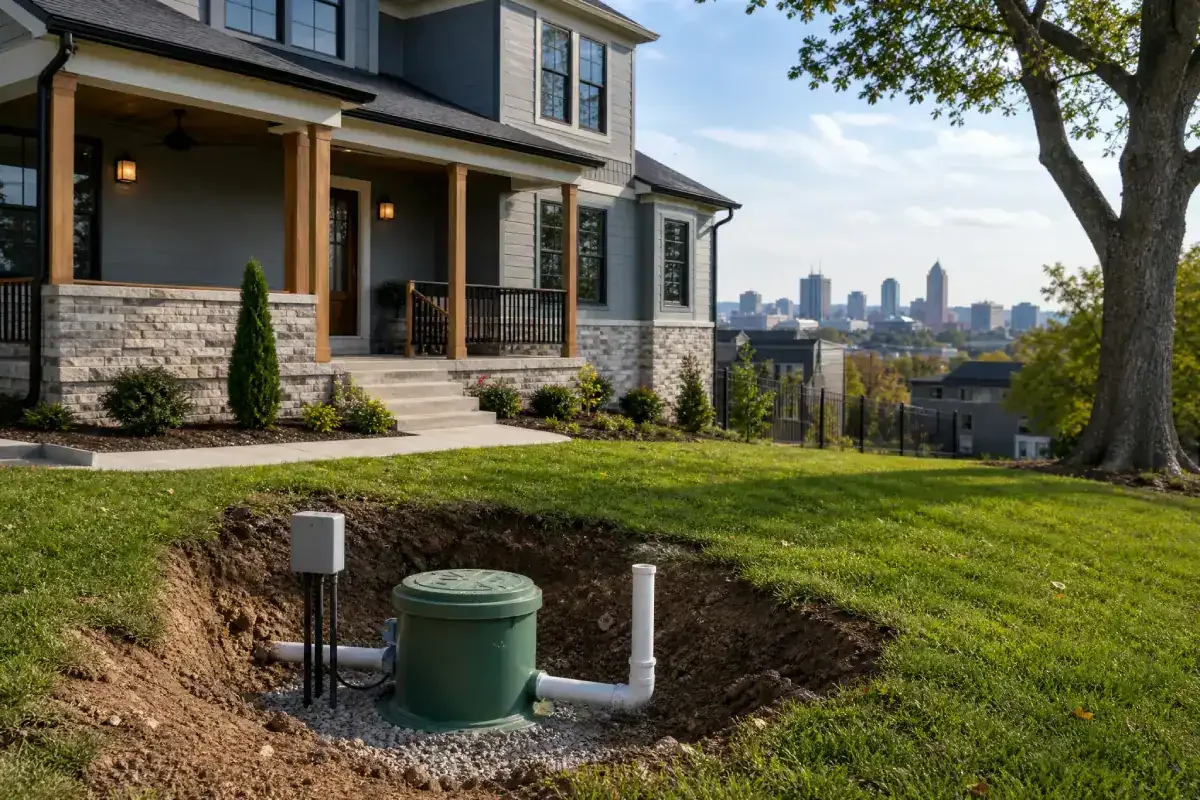
Quick Answer: A grinder pump is a self-contained system with a collection tank, pump, controls, and alarm that collects household wastewater, grinds it into slurry, and forces it uphill through small-diameter pipes to Nashville’s municipal sewer main. Properties sitting below the sewer line or far from a gravity connection typically need one, since gravity alone cannot move wastewater uphill. Prodigy Sewer & Drain installs and services grinder pump systems throughout Davidson County and Middle Tennessee.
Grinder pumps collect all wastewater from a home and grind it into slurry, then push it through small-diameter pipes into Nashville’s municipal sewer system. Nashville properties sitting below the main sewer line typically require one. We serve Davidson County and surrounding Middle Tennessee areas, helping homeowners determine whether a grinder pump installation is necessary for their specific site.
What Exactly Is a Grinder Pump?
A grinder pump is a self-contained appliance made up of four core components: a collection tank, a small pump, on-off controls, and a high-water alarm. The grinder pump system collects all wastewater from a home, grinds it into a fine slurry, and forces that slurry through a small-diameter pipe to the sewer main in the street. For the exact specifications Metro Water requires, see the Metro Water grinder pump user instructions.
Many Nashville properties — especially those in low-lying areas or at the end of long sewer runs — rely on grinder pumps because gravity alone cannot move wastewater uphill to the municipal line. Without a functioning grinder pump, raw sewage backs up inside the home. That’s a health hazard, not just an inconvenience.
What Are the Main Parts of a Grinder Pump?
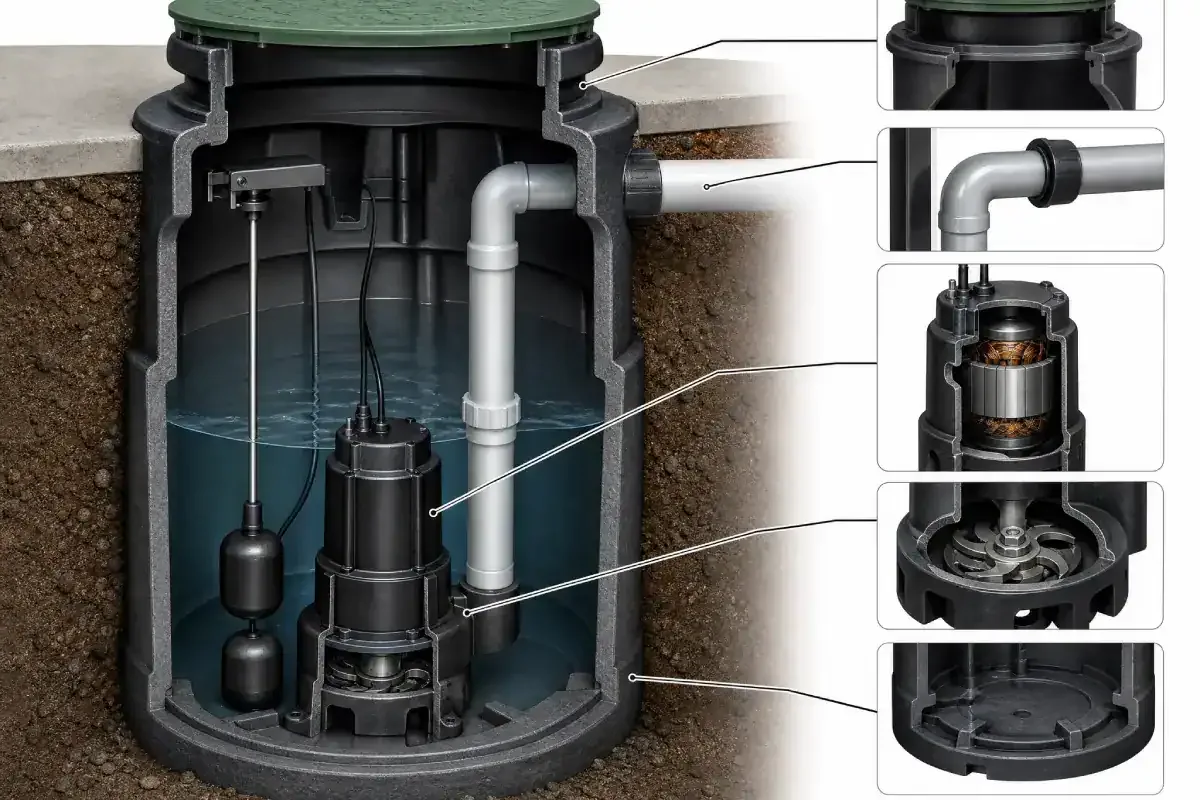
Every grinder pump installation includes the same essential components:
- Collection tank — holds incoming wastewater from the home
- Pump assembly — grinds solids and pressurizes the slurry for discharge
- On-off controls — monitor tank levels and trigger the pump automatically
- High-water alarm — alerts homeowners when the tank reaches a critical level
The pump is powered by electricity and connects to a control panel mounted near the tank. That control panel is wired to an exterior breaker box and draws from a dedicated circuit in the home’s main electrical panel.
How Long Does a Grinder Pump Run Each Cycle?
A grinder pump typically runs for one to two minutes per cycle. The pump shuts off automatically once the wastewater inside the tank drops to a preset level. Short, frequent cycles are normal. Extended run times or a pump that never shuts off signal a problem that needs professional attention.
We serve Nashville homeowners across Davidson County and surrounding Middle Tennessee communities. If a grinder pump issue arises, our emergency sewer and drain services team diagnoses and resolves it fast — before a small malfunction becomes a costly sewage emergency.
How Does a Grinder Pump System Work?
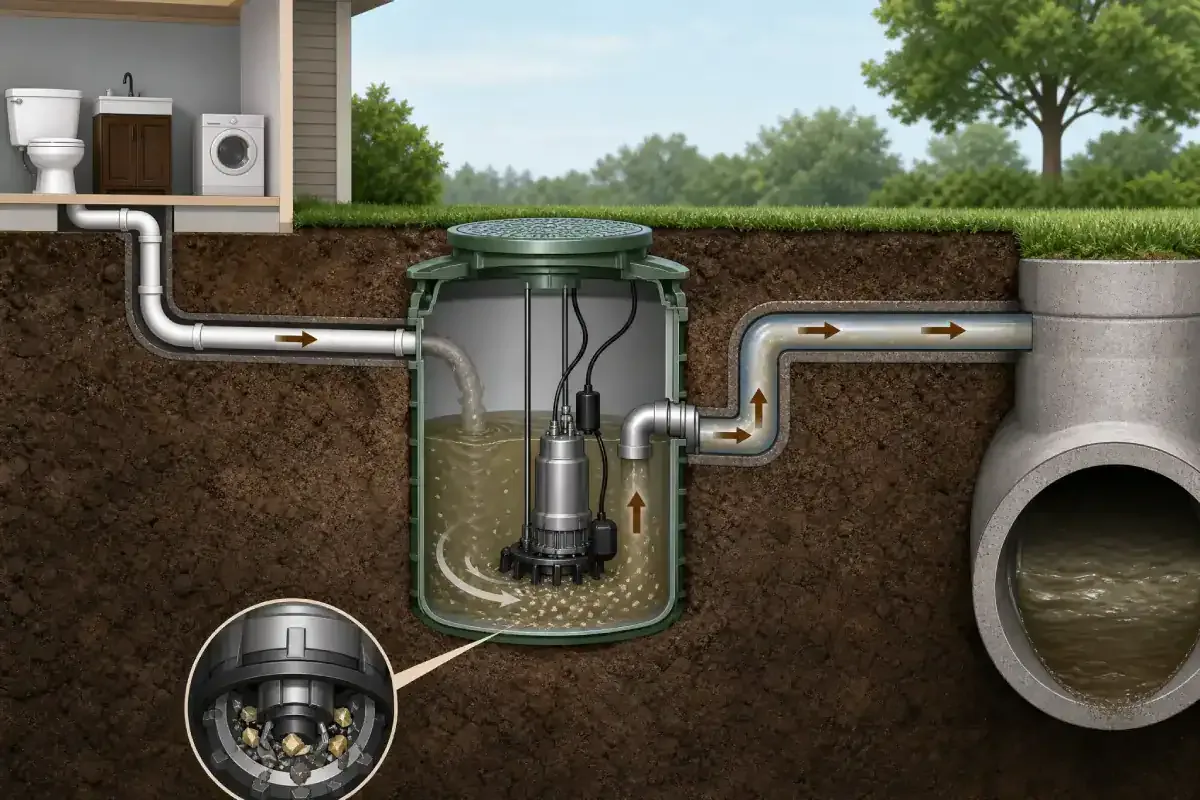
A grinder pump system collects all wastewater from a home, pulverizes solid waste into a fine slurry, then uses pressure to force that slurry upward through small-diameter pipes to the main sewer line. Gravity alone cannot move wastewater uphill — the grinder pump solves that problem mechanically.
Here is the basic sequence our technicians explain to Nashville homeowners:
- Collection — All wastewater from the home drains into the grinder pump station’s holding tank.
- Grinding — The pump’s cutting mechanism pulverizes solid waste material into a fine slurry.
- Pressurized discharge — The pump forces the slurry upward and outward through small-diameter pipes toward its destination.
- Delivery — The slurry reaches a wastewater treatment plant, a gravity manhole, a larger sewer main, or a septic system.
What Happens to the Pipes in a Pressure Sewer System?
A pressure sewer system uses small-diameter pipes buried just below the frost line. Unlike traditional gravity sewer lines that require a constant downhill slope, these pipes follow the natural contours of the land, rising and falling with Nashville’s varied terrain. That flexibility — outlined in the EPA’s wastewater technology fact sheet on pressure sewers — makes pressure sewer systems practical in areas where conventional gravity systems would require costly deep excavation.
Why Does a Grinder Pump Need to Force Wastewater Upward?
Wastewater cannot travel uphill on its own. Homes located below or far from the main sewer line need a mechanical boost. The grinder pump provides that boost by converting solid waste into pressurized slurry, ensuring wastewater reaches the treatment facility reliably. We see this situation frequently across Nashville neighborhoods built on rolling or low-lying ground.
? Ready to Get Started? If you’re unsure whether your Nashville property needs a grinder pump, don’t guess — contact Prodigy Sewer & Drain today for a professional site assessment and a free, no-obligation quote.
Does Your Nashville Property Need One?
Nashville properties sitting below or far from the nearest gravity sewer main almost certainly need a grinder pump. What is a grinder pump in this context? It is the mechanical solution that moves wastewater uphill when gravity alone cannot do the job.
Nashville’s terrain makes this more common than many homeowners expect. The city’s mix of historic neighborhoods and newer developments means elevation changes are frequent, and some properties simply sit at the wrong end of that grade. When a home is positioned below the municipal sewer main, wastewater has no natural downhill path to follow. Without a pump to provide that boost, the system fails.
Which Nashville Properties Are Most Likely to Need One?
Properties that fall into any of these categories are strong candidates:
- Homes built below street level, where the sewer main runs higher than the lowest drain in the house
- Lots located far from the nearest gravity sewer connection, where the distance makes a standard gravity line impractical
- New developments on the urban fringe, where infrastructure hasn’t caught up to the terrain
In some Nashville neighborhoods, a grinder pump isn’t optional — it’s the only code-compliant path to proper wastewater handling, consistent with Tennessee’s design criteria for small alternative wastewater systems.
What Happens if a Property Needs One but Doesn’t Have One?
Without a grinder pump, wastewater backs up. Drains slow, fixtures overflow, and raw sewage can enter the home. The damage is costly and the health risk is real. Gravity-dependent systems simply cannot push waste uphill, no matter how well the rest of the plumbing is maintained.
Our team serves Nashville properties across Davidson County and the surrounding Middle Tennessee area. We assess each site individually and recommend the right solution for the specific elevation and distance challenges your property presents.
What Can Damage or Stress a Grinder Pump?
Grinder pumps are complex systems with multiple interdependent components. Neglecting any one of them puts the entire unit at risk. Treating a grinder pump like a septic system is one of the most common — and costly — mistakes Nashville homeowners make.
A grinder pump is not a septic system. Septic systems are designed to handle biological breakdown on-site. Grinder pumps are not. Flushing materials that belong in a septic tank — grease, wipes, or fibrous waste — can jam the pump assembly and trigger failures across the whole system.
What Components Are Most Vulnerable to Damage?
Understanding what is a grinder pump means recognizing how many parts must work together. A grinder pump system includes:
- Tank — collects all household wastewater before processing
- Pump assembly — grinds solids into slurry for transport
- Level controls — signal the pump to activate and shut off
- Piping and valves — move the slurry to the main sewer line
- Electrical components — power the entire operation
Any single failure in this chain stresses the remaining parts. Level controls that malfunction, for example, can cause the pump to run dry and burn out the motor.
Does Proper Maintenance Really Make a Difference?
Absolutely. Properly maintained grinder pumps are reliable systems Nashville homeowners can depend on for years. Neglected units, by contrast, face cascading failures. A stressed pump assembly strains the valves, which then compromise the piping connections.
Our team at Prodigy Sewer & Drain serves Nashville with expert grinder pump inspections and repairs, catching small stressors before they become expensive emergencies.
Who Should Nashville Homeowners Call for Help?
Nashville homeowners dealing with grinder pump problems need a licensed, experienced sewer specialist — not a general handyman. Prodigy Sewer & Drain is a family-owned trenchless sewer company based in Franklin, TN, serving Nashville and all of Middle Tennessee, backed by more than 13 years of hands-on experience.
Our team holds NASSCO certifications and certified Perma-Liner installer credentials, meaning we diagnose and repair sewer systems to a nationally recognized standard. That level of credentialing matters when a failing grinder pump threatens your home’s entire wastewater system.
What Qualifications Should a Grinder Pump Technician Have?
Look for a contractor who is licensed, insured, and bonded. All three protect you if something goes wrong on the job. Our technicians carry every one of those credentials, and our NASSCO certification adds an extra layer of technical accountability that general plumbers rarely hold.
Does Prodigy Sewer & Drain Serve My Nashville Neighborhood?
We cover Nashville and the broader Middle Tennessee region, including Davidson County and Williamson County communities such as Brentwood, Nolensville, Belle Meade, West Meade, Spring Hill, and Thompsons Station. If you’re unsure whether your address falls within our service area, a quick call confirms it.
Our service area at a glance:
- Nashville and Davidson County
- Brentwood, Franklin, and Williamson County
- Nolensville, Spring Hill, and Thompsons Station
- Belle Meade and West Meade
We are available 24/7 for emergencies. A grinder pump failure at midnight gets the same expert response as a scheduled appointment. When wastewater stops moving, fast action prevents costly backups — and we are ready to respond.
Frequently Asked Questions
What Is the Difference Between a Grinder Pump and a Gravity Sewer System?
A gravity sewer system relies on a downhill slope to move wastewater from your home to the municipal sewer main — no mechanical assistance required. A grinder pump system is used when that natural slope doesn’t exist. It grinds solid waste into a fine slurry and uses pressure to push that slurry uphill through small-diameter pipes to the sewer main. Nashville properties on low-lying terrain or at the end of long sewer runs almost always require a grinder pump rather than a traditional gravity connection.
How Do I Know if My Nashville Home Already Has a Grinder Pump Installed?
The most visible clue is a small above-ground or flush-mounted control panel — typically a gray or green box — located near your home’s exterior, often close to where the sewer lateral exits the house. There will also be a dedicated electrical circuit in your breaker panel labeled for the pump, and you may notice a high-water alarm light or audible alert on the control box. If you’re unsure, a licensed sewer technician with camera inspection equipment can confirm whether a grinder pump system is present and functioning correctly.
What Should Nashville Homeowners Never Flush Into a Grinder Pump System?
Grinder pumps are designed to handle normal household wastewater — toilet waste, sink water, and shower drainage — but they are not built for the same materials a septic system can tolerate. Never flush grease, cooking oils, ‘flushable’ wipes, paper towels, feminine hygiene products, fibrous food waste, or any non-biodegradable solids. These materials jam the pump’s cutting mechanism, cause premature motor burnout, and can trigger failures across the entire system.
What Does a Grinder Pump High-Water Alarm Mean, and What Should I Do?
A high-water alarm activates when the wastewater level inside the grinder pump’s collection tank rises above a safe threshold — typically indicating that the pump has stopped cycling properly. Common causes include a power outage to the pump circuit, a tripped breaker, a failed float switch, or a jammed cutting assembly. When the alarm sounds, reduce household water use immediately to avoid overflow, check that the pump’s breaker is not tripped, then call a licensed sewer technician to diagnose the cause.
Who Is Responsible for Maintaining a Grinder Pump — the Homeowner or Metro Nashville Water Services?
Responsibility depends on whether the grinder pump is part of a municipally managed low-pressure sewer program or a privately owned system installed on the homeowner’s property. In Metro Nashville Water Services grinder pump programs, the utility typically owns and maintains the pump station itself. However, homeowners are generally responsible for the electrical supply to the unit and for what goes into it — meaning flushing prohibited materials can void program protections. For privately owned systems, full maintenance and repair responsibility falls to the homeowner.
TL;DR — Grinder Pumps at a Glance
- A grinder pump collects household wastewater, grinds it into slurry, and pumps it to the sewer main.
- The system includes 4 core components: a collection tank, pump, on-off controls, and a high-water alarm.
- Nashville properties on low-lying terrain or far from gravity sewer lines typically require grinder pumps.
- Prodigy Sewer & Drain, based in Franklin, TN, installs and services grinder pump systems across the Nashville area.
- Next step: Schedule a free site assessment with Prodigy Sewer & Drain to find out if your property needs a grinder pump.
Related Resources
- Grinder Pump Installation Services
- Nashville, TN Service Area
- Nashville’s Aging Sewer Infrastructure Crisis
- Sewer Line Inspection Near Nashville
- Trenchless Sewer Repair in Nashville
- Sewer Scope Inspection Before Buying a Home
Get a Free Grinder Pump Assessment
Understanding whether your Nashville property needs a grinder pump comes down to one question: does your plumbing sit below the municipal sewer line? Prodigy Sewer & Drain has helped homeowners across Davidson County and Middle Tennessee answer that question for more than 13 years, installing and servicing grinder pump systems that keep wastewater moving reliably. Contact Prodigy Sewer & Drain today for a free, no-obligation quote.
About Prodigy Sewer & Drain: Prodigy Sewer & Drain is a family-owned trenchless sewer company based in Franklin, TN, serving Nashville, Davidson County, and Williamson County for more than 13 years. The team specializes in grinder pump installation, repair, and inspection, backed by NASSCO certification and certified Perma-Liner installer credentials. Contact us today for a free, no-obligation quote.
Catch Septic Trouble Before It Surfaces
Inspection, pumping, repair and grinder pumps across Davidson and Williamson counties — from a crew that will tell you when the system is fine. Call or text (629) 276-6322.