How Do You Plunge a Toilet the Right Way?
Quick answer: To plunge a toilet, use a flange plunger, add enough water to cover the rubber cup, seat the flange firmly in the drain opening, and pump straight up and down 15–20 times before pulling the seal off sharply. Most everyday clogs clear in under two minutes.
If the bowl still backs up after three or four rounds, the blockage sits deeper than your toilet trap, and that calls for professional drain cleaning rather than more elbow grease.
What's in This Post
- What kind of plunger works best on a toilet?
- What should you do before you start plunging?
- How do you plunge a toilet step by step?
- How long should you keep plunging?
- What should you never do to a clogged toilet?
- What if plunging doesn’t work?
- When is a clogged toilet actually a sewer line problem?
- How do you keep it from happening again?
- Conclusion / TL;DR
- Frequently Asked Questions
- Related Questions
What kind of plunger works best on a toilet?
A flange plunger is the right tool. It has a soft rubber sleeve that folds out from the bottom of the cup, and that sleeve is what seals against the curved drain opening in a toilet bowl.
The flat-bottomed cup plunger under most kitchen sinks will not work here. It seals nicely against a flat surface, so it belongs on sink and tub drains. On a toilet, the flat rim can’t grip the curve, so most of your force escapes around the edges.
| Flange plunger | Cup plunger | |
|---|---|---|
| Shape | Rubber sleeve extends from cup | Flat rubber dome |
| Best for | Toilets | Sinks, tubs, floor drains |
| Seal on a toilet | Tight and reliable | Poor — pressure escapes |
| Typical cost | $10–$20 | $5–$12 |
A quick tip before you start: run the rubber under hot tap water for 30 seconds. Warm rubber flexes better and forms a stronger seal.
What should you do before you start plunging?
Two minutes of prep saves a much bigger mess later.
- Stop the bowl from overflowing. Lift the tank lid and press the flapper down by hand. That closes off the water and buys you time.
- Shut the supply valve. Turn the small oval knob behind the toilet clockwise until it stops.
- Check the water level. You want the bowl about half full — enough to cover the plunger cup completely. Too little water and you’re pushing air, which does nothing. Too much and you’ll splash. Add water with a pitcher or bail some out with a cup.
- Protect the floor. Lay old towels or newspaper around the base.
- Wear gloves. Rubber gloves and eye protection are worth it, especially if the water has already backed up.
How do you plunge a toilet step by step?
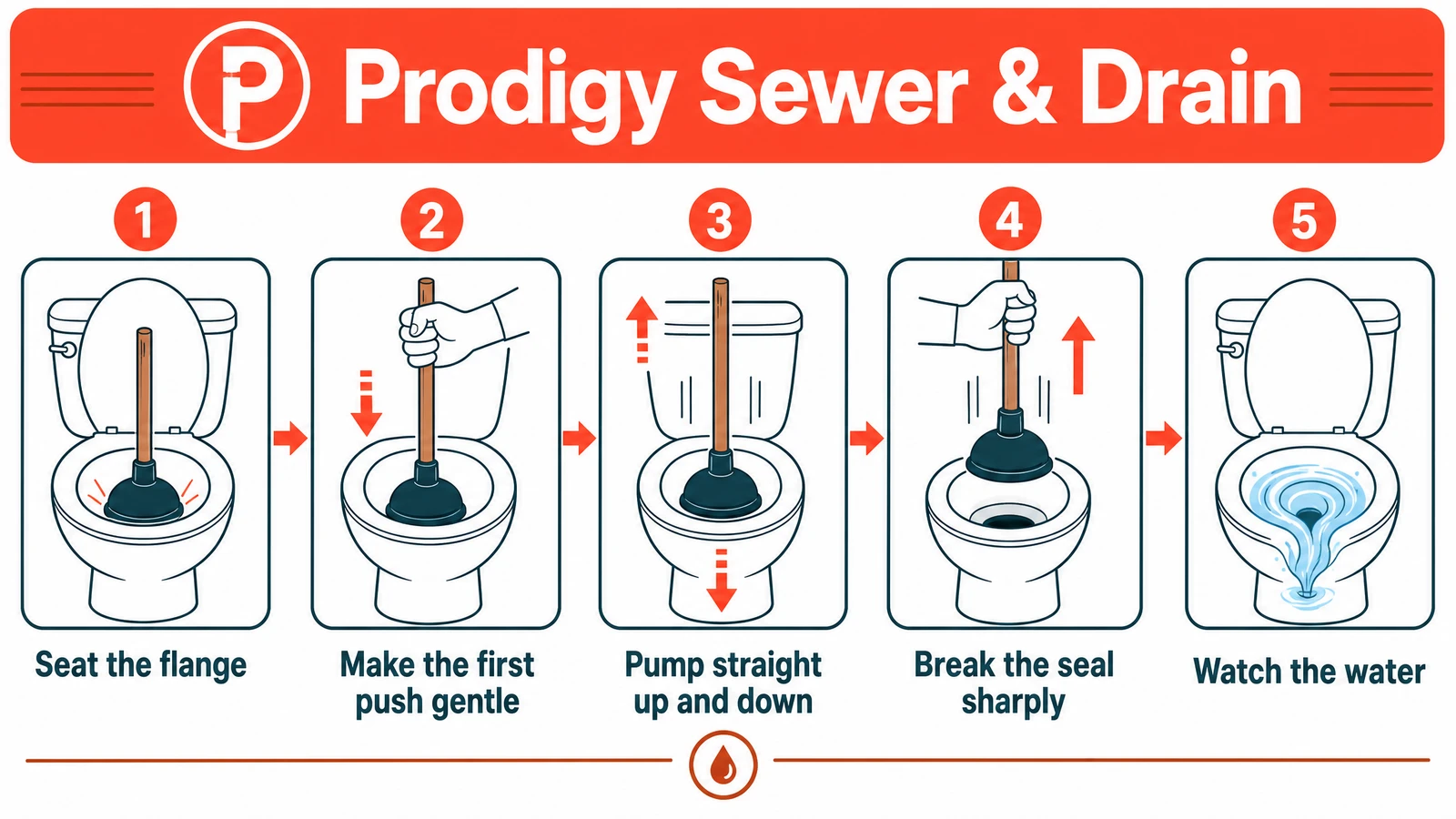
Step 1: Seat the flange
Fold the rubber sleeve all the way out. Lower the plunger into the bowl at an angle so the cup fills with water instead of trapping air. Then push the flange into the drain opening until it sits snugly.
Step 2: Make the first push gentle
Your first plunge should be slow and light. The cup is full of air, and a hard shove sends dirty water straight back at you. One easy push clears that air out.
Step 3: Pump straight up and down
Keep the seal intact and pump vertically with firm, steady strokes. Fifteen to twenty strokes is a normal round. The pull stroke matters as much as the push — the suction loosens the clog from both directions.
Step 4: Break the seal sharply
After your last stroke, yank the plunger up fast. That sudden pull often does the work all the pushing set up.
Step 5: Watch the water
If the water drains out with a strong swirl, you’re done. Open the supply valve, let the tank refill, and flush once to confirm. If the level barely moves, add water back to the halfway mark and run another round.
How long should you keep plunging?
Give it three or four rounds of 15–20 strokes, with a short rest between each. That’s roughly two to three minutes of real effort.
A toilet clog that’s going to clear will usually clear in that window. Past that point, you’re not building pressure anymore — you’re just stressing the wax ring under the toilet base and risking a leak you can’t see. Stop and reassess instead.
What should you never do to a clogged toilet?
- Don’t reach for chemical drain cleaner. Those products are made for hair and soap in a sink line. In a toilet, they sit in standing water, generate heat, and can crack porcelain or damage older pipe. If the clog doesn’t move, you’ve now got a bowl of caustic liquid to deal with.
- Don’t pour boiling water in. Rapid temperature change can crack a cold porcelain bowl. Hot tap water is fine; a kettle is not.
- Don’t keep flushing. Every flush adds more water to a bowl that already can’t drain.
- Don’t force a metal snake in blind. A rigid cable can scratch the glaze or chip the trap. A toilet auger with a protective rubber sleeve is the correct tool.
- Don’t ignore the other drains. If your tub gurgles while you plunge the toilet, put the plunger down. That’s a signal from further down the line.
What if plunging doesn’t work?
Move to a toilet auger (also called a closet auger). It’s a short, flexible cable inside a protective tube, built specifically for the bend in a toilet trap. Feed the cable in, crank the handle clockwise, and you’ll either break the obstruction apart or hook it and pull it out.
If the auger also comes up empty, the clog isn’t in the toilet at all. Something is restricting the branch line or the main line beyond it, and no handheld tool reaches that far.
At that stage, a technician runs a sewer camera inspection to see exactly what’s down there — a collapsed section, root intrusion, a grease buildup, or an object lodged at a joint. Looking first means you fix the actual problem instead of guessing at it.
When is a clogged toilet actually a sewer line problem?
One slow toilet is usually just a toilet. But a few patterns point to something bigger:
- Multiple fixtures back up at once. Toilet, shower, and washing machine drain slowly on the same day.
- Water appears in the wrong place. You flush the toilet and water rises in the tub or shower.
- Gurgling sounds. Air trapped behind a partial blockage escapes through the nearest open drain.
- It keeps coming back. You plunge it clear, and it clogs again within a week or two.
- Odor near floor drains or in the yard. A steady sewer smell suggests a break or a standing pool of waste.
These are classic sewer line backup warning signs, and they don’t resolve on their own. In older Middle Tennessee neighborhoods, mature trees are a frequent culprit — tree roots find their way into sewer lines through small cracks and joints, then grow into a mesh that catches everything passing through.
If waste is already backing up onto your floor, that’s an emergency. Stop using water in the house and call for 24/7 emergency drain cleaning right away.
How do you keep it from happening again?
Most repeat toilet clogs trace back to two habits, and both are easy to change.
Flush only the three P’s — pee, paper, and waste. Wipes labeled “flushable” are the biggest offender. They pass through the bowl, then fail to break down the way toilet paper does. Metro Water Services has documented how badly this affects Nashville’s system, and their sewer clog prevention guidance lists the items that cause the most trouble locally. Paper towels, cotton swabs, dental floss, and hygiene products all belong in the trash.
Know your toilet’s flush volume. Federal standards cap new toilets at 1.6 gallons per flush, and EPA WaterSense labeled models use 1.28 gallons or less while still meeting independent performance testing. Efficient models are excellent, but they leave less margin for error — a wad of thick paper that a 3.5-gallon toilet from 1985 would have carried away can stall in a modern low-flow line. Two smaller flushes often beat one big one.
A few more habits that help:
- Keep a small trash can within reach of the toilet so guests aren’t tempted to flush.
- Teach kids the “one square at a time” rule for toilet paper.
- Have a flange plunger and a toilet auger on hand before you need them.
- Schedule a professional line cleaning every 18–24 months if your home is older or surrounded by mature trees.
If you’re clearing clogs more than a couple of times a year, it’s worth reading up on why drains keep clogging in Nashville homes — the underlying cause is often structural rather than behavioral.
Conclusion / TL;DR
- Use a flange plunger, not the flat cup plunger from under your sink.
- Shut off the supply valve and set the water level so it covers the rubber cup.
- First push gentle, then 15–20 firm vertical strokes, then break the seal sharply.
- Stop after three or four rounds. More force won’t help and may loosen the wax ring.
- Never use chemical drain cleaner or boiling water in a toilet.
- A toilet auger is the next step, and it’s built to protect the porcelain.
- Multiple slow drains, gurgling, or repeat clogs mean the problem is in your sewer line, not the toilet.
- Prevention is simple: flush only the three P’s, and get older lines cleaned every 18–24 months.
Frequently Asked Questions
What kind of plunger works best on a toilet?
A flange plunger. Its extended rubber sleeve seals against the curved drain opening in a toilet bowl. A flat cup plunger is designed for sinks and tubs and cannot form a proper seal on a toilet.
How long should you plunge a toilet?
Three or four rounds of 15 to 20 strokes, roughly two to three minutes total. If the clog has not cleared by then, stop plunging and move to a toilet auger or call a professional.
Can you use chemical drain cleaner in a toilet?
No. Chemical drain cleaners sit in the standing water of a toilet bowl, generate heat, and can crack porcelain or damage older pipe. Use a flange plunger or a toilet auger instead.
When is a clogged toilet a sewer line problem?
When multiple fixtures drain slowly at once, water rises in the tub while the toilet is flushed, drains gurgle, or the same toilet clogs repeatedly within days or weeks. These point to a blockage in the branch or main sewer line rather than the toilet trap.
Still Backing Up? Let’s Take a Look.
You shouldn’t have to keep a plunger on standby. If your toilet clogs again and again, or if more than one drain is slow, our licensed team can find the real cause and fix it without tearing up your yard. Request a free consultation with Prodigy Sewer & Drain — camera inspection, honest assessment, clear pricing before any work starts.